
Aircraft:
North American B-25 “Mitchell”
Current Status:
Flyable
History:
The North American B-25 Mitchell is an American medium bomber that was introduced in 1941 and named in honor of Major General William “Billy” Mitchell, a pioneer of U.S. military aviation. Flown by many Allied air forces, the B-25 served in every theater of World War II, and after the war ended, many remained in service, operating across four decades. Produced in numerous variants, nearly 10,000 B-25s were built. These included several variants including the USN, and USMC PBJ-1 patrol bomber.
The B-25 became etched in the public lexicon as the bomber used in the 18 April 1942 Doolittle Raid, in which 16 B-25Bs led by Lieutenant Colonel Jimmy Doolittle attacked mainland Japan after launching from the deck of the USS Hornet 600 miles off the coast of Japan. The attack came four months after the bombing of Pearl Harbor and would be the first blow to the Japanese Empire to avenge the attack on Pearl Harbor on December 7th, 1941. The heroic mission would be a welcome morale boost to the American public during the early days of WWII where US combat success had been limited. It was also a blow to the Japanese psyche, as the Japanese had believed their home islands to be out of reach by enemy forces.
About Our North American B-25 “Mitchell”:
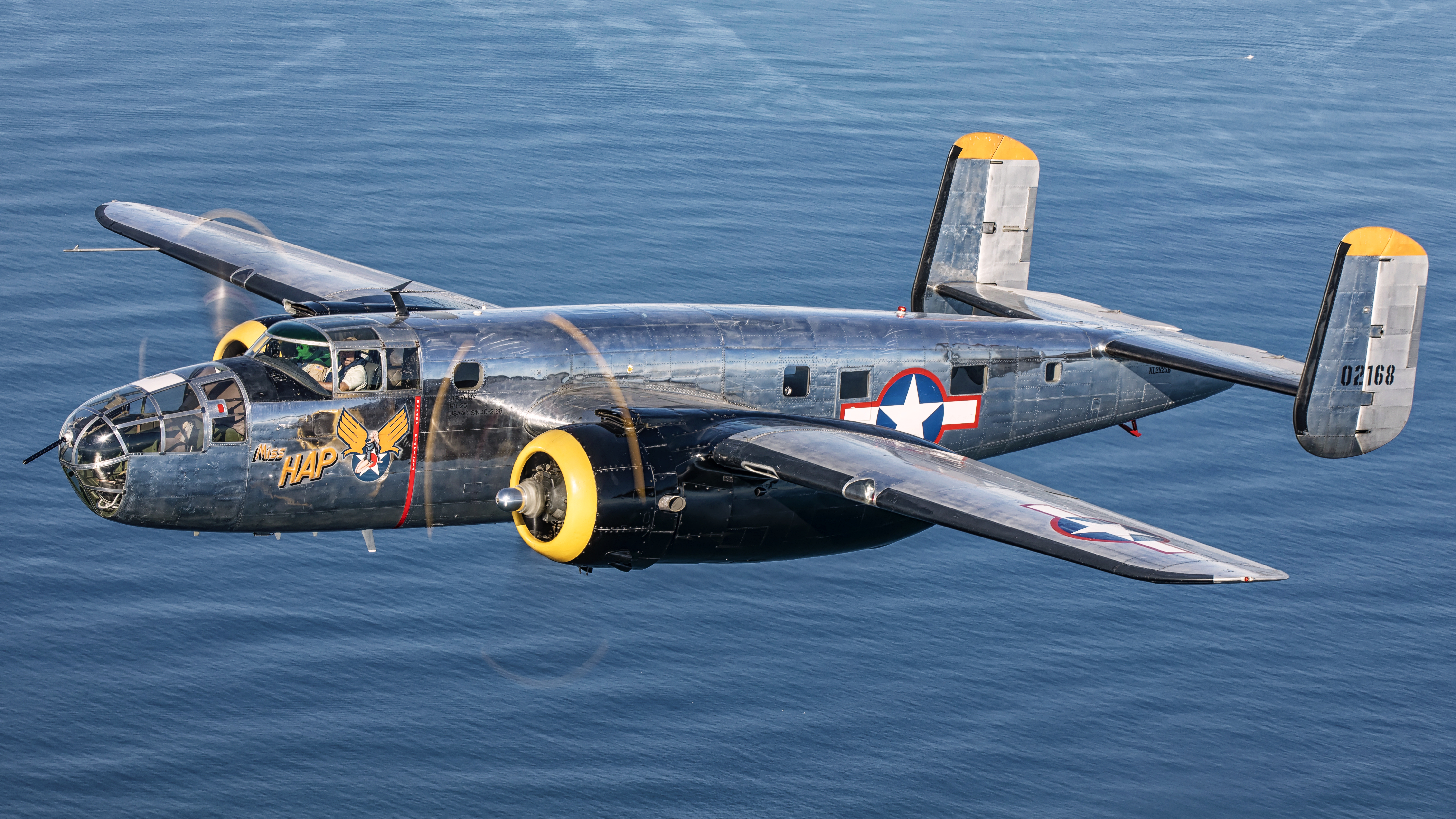
The American Airpower Museum North American B-25 Mitchell “Miss Hap” is the oldest surviving example of the B-25 “Mitchell”. Built in 1940/41 at the North American Aviation plant in Inglewood, CA, now adjacent to where LAX stands today, it was part of the first 24 built for the US Army Air Corps as part of President Roosevelts pre-war build up. The first B-25 delivered to the USAAC on February 25th of 1941 at Mchord Field in Washington State, it was assigned to the 17th Bomb Group, 34th Bomb Squadron. It flew with the 17th BG through 1942 and participated in the famed pre-war exercise known as the Louisiana Maneuvers. When the 17th BG moved to South Carolina in 1942, 40-2168 was transferred to Orlando Army Air Field, and then quickly to Westover Field in Massachusetts where it would join bomb groups acting as Anti-Submarine units along the east coast. Beginning in July of 1942 it was assigned to multiple bases from Aberdeen Maryland, to Romulus AAF in Detroit. In July of 1943 it was transferred to the North American Factory in Inglewood, California where like its sister ship serial number 40-2165 it was converted into a VIP Executive transport. After its conversion B-25 40-2168 was presented by North American Aviation President “Dutch” Kindleberger to General Henry “Hap” Arnold, Commander of the USAAF to be used as his personal transport. It was permanently transferred to what became the 1st AAF Base Unit HQ at Bolling Field Washington DC the same month its conversion began in 1943 and would serve as General “Hap” Arnolds personal executive transport from there through 1944. After being replaced by a newer B-25J in December of 1944 40-2168 would return to NAA temporarily and although historical records aren’t clear for its operational history in 1945 it most likely served in an administrative transport role up to the time it was removed from service and placed in storage for eventual surplus in July 1945 at McClellan Field, CA. Purchased surplus in 1947 it went through two owners until 1951 when purchased by Hughes Aircraft owned by Howard Hughes who operated it until 1962. After it was sold to various civilian owners through the 1960s, 70s, and 80s it was purchased by Jeff Clyman, founder of the well-known flight jacket manufacturer Avirex Ltd, now known as Cockpit USA in 1989. It is now part of the American Airpower Museum collection and has been flying in air shows around the country now for over 30 years.